The Melian Dialogue
At the time of writing this, there was a strike on Iran in what is known as Operation Epic Fury. We are also in the midst of a genocidal colonial project taking place in Gaza, and it seems to now include the West Bank.
All this geopolitics tensions reminds me of the Melian Dialogue, a lesson on realist political theory.
What was the Melian Dialogue?
The Melian Dialogue is one of the most famous and chilling passages in ancient political thought. It appears in Book V of ‘History of the Peloponnesian War’ by Greek historian Thucydides. Took place nearly 2,500 years ago, it recounts a negotiation during the Peloponnesian War between imperial Athens and the small island of Melos.
War broke out between Athens and Sparta. Athens, which at that time was a superpower in the Greek archipelago, quickly set about to bring all other Greek islands under their control. They finally reach a small island of Melos.
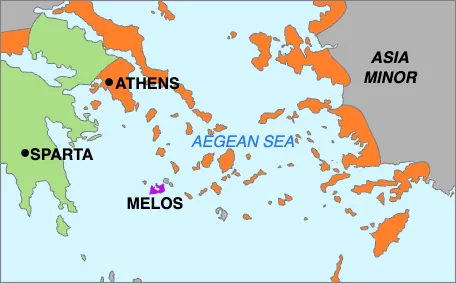
Melos was a neutral island with cultural ties to Sparta. Athens, at the height of its power, demanded that Melos submit to Athenian rule, pay tribute, and serve the empire. The Athenians warned that refusal would mean destruction.
What was now known as the Melian Dialogue was the corresponding back-and-forth between the Melos islanders and the Athenians.
The Melos islanders plead and argue their case, stating what the Athenians are doing is unjust. They emphasise their neutrality and that attacking a neutrality is wrong and unjust.
The Athenians rejected all moral arguments. This is where the famous line from the dialogue was said:
The strong do what they can, and the weak suffer what they must
This captures the brutal realism of Athenian logic; justice only applies between equals in power. In the real world, power determines outcomes. Submitting is rational; resisting is suicidal.
Melos chose honour and justice, they refused to surrender, and chose to resist Athens’ occupation, they chose to defend their homeland. True to their word, the Athenians then conquer the tiny island, executing all military-age men and selling the women and children into slavery. Hundreds of Athenians then settle on the island, ensuring the total erasure of Melos.
Did Melos make the right decision?
Throughout the years, this has been a debate in the realm of realist political theory. The dialogue reflects the idea the ‘power’ governs international politics, not ‘morality’. States in power will act out of self-interest.
The Romans, years after, pondered on this question. Vegetius, a 4th-5th century Roman military writer, coined the saying:
Si vis pacem, para bellum
Which translated to the famous saying:
If you want peace, prepare for war
The idea become a core principle of Roman military doctrine. This is the only way of deterrence to “The strong do what they can, and the weak suffer what they must”, which is to the Roman, never become ‘weak’.
In modern times
Surely, these saying only applied to the ancient times, right? Today, we have the United Nations, dense economic interdependence, international laws, treaties, and conventions. We are living in the modern age, in the era of multilateralism, and rules-based international order, surely justice, morality, and ethics are preserved, right?
Surely, the strong cannot do what they can, and the weak does not need to suffer what they must, right?
I am writing this as the genocide in Gaza was going on. The slow and painful erasure of the Palestinian people from their land done by the vicious Zionist conquerer. “The strong do what they can, and the weak suffer what they must.”
As I’m writing this, the news feeds tells me that an unprovoked strike on Iran has just begun, and a retaliatory action was taken by Iran, where Israel and U.S. military based across the gulf region was targeted. “If you want peace, prepare for war.”
Has the world since ancient times and in modern times been an anarchy? Technology changed, institutions evolved, new normal emerges, but human nature remain constants. Thucydides did write that the events he described would happen again because human nature does not change.
The Dark Forest
Reading book two of Cixin Liu’s ‘Remembrance of Earth’s Past’ trilogy, known to most by the title of the first book in the trilogy, “The Three-body Problem”, I was introduced to the ‘Dark Forest theory’. I think he pushes this conversation to a cosmic extreme.
The Dark Forest theory states that, every civilisation is a hunter, no one civilisation knows what the other civilisation’s intentions. Survival is the top priority. Therefore, the safest strategy is to destroy others before they destroy you, or if you do not have the capabilities, stay hidden in the wide cosmos.
But in this small rock orbiting the sun, it is no longer possible for any country to ‘stay hidden’. Therefore, stronger nations do what they can to stay on top, keeping weaker nation weak so that they will not become dominant tomorrow. So the rational move is preemptive annihilation or submission. (‘preemptive strike’ was the term Israel used when they strike Iran). To ‘stay hidden’ in these modern times is to stay silent, and not challenge the status-quo.
The Dark Forest theory removes, diplomacy, trust, neutrality, and mercy.
Laws only works when it is enforced. International laws failed because the ones powerful enough to enforce it are bending the rules for their own self-interest.
Perhaps the only way we might see peace is if the entire world had gone MAD, Mutually Assured Destruction. A global ‘Mexican-standoff’ where every one is pointing their guns are everyone. As long as nobody pulls the trigger, everyone is safe. But once one person pulls the trigger, it's mutual destructions for everyone.

But, is this stability? Or permanent mutual hostage-taking? Is fear-based peace actually peace?
Something to ponder upon,
until the next note.
May peace be upon you.
Jibone.
This was first posted on Jibone’s Fleeting Notes, a newsletter. Subscribe to receive new notes entries in your inbox.